Talent4cast
Jamie Dillon
Founder
“Jenn ran a 30-minute diagnostic that gave me more clarity than I’d built in the previous year.”Read the founder story
We don't support revenue. We generate it.
Deep in HRTech and FinTech.
We design, install, and operate AI-powered revenue systems for founders who don't yet have a repeatable revenue engine — or had one that broke under growth. Turning founder-led traction into new, repeatable, forecastable revenue.
End-to-end go-to-market — from ICP strategy to inbound and outbound engines to running the motion itself. Delivered the way your stage demands:
Built by operators who've scaled revenue from $0 to $30M and $25M to $150M.
The operator experience behind Gradient GTM
0x
Revenue growth driven over 8 years in enterprise GTM
$0B
Strategic exit value at 35% above market
$0M
Vertical scaled from $25M under direct leadership
$0M
New product built from zero to revenue in 3 years
Talent4cast
Jamie Dillon
Founder
“Jenn ran a 30-minute diagnostic that gave me more clarity than I’d built in the previous year.”Read the founder story →
Greatpoint HR
Andrew Kalogerakis
Founder
“Jenn picked up the patterns in our motion fast and gave us a phased plan instead of a list of opinions. That’s the kind of voice you want in the room.”Read the founder story →
Work with us if you're trying to
You're closing deals but can't replicate it...
You're closing deals but can't replicate it. The process lives in your head. We codify it into a system that scales — whether you're at $2M or $30M ARR.
Most teams grow pipeline by adding people...
Most teams grow pipeline by adding people. We build the motion, the tools, and the playbooks that make your existing team operate at 2x output.
GTM role sequencing, hire timing, and org design...
GTM role sequencing, hire timing, and org design across sales, marketing, CS, and RevOps — every hire lands in a system built to make them succeed from day one.
Investors fund GTM confidence...
Investors fund GTM confidence. ICP clarity, a repeatable motion, and a defensible revenue architecture are what move the needle on your Series A or B valuation.
Build the lead engine and outbound motion...
Build the lead engine, demand gen programs, and outbound motion that puts you consistently in front of the right buyers — at every stage of growth.
Your existing customer base is your most underleveraged growth asset...
Upsell architecture, cross-sell motion, and customer reference programs — your existing customer base is your most underleveraged growth asset. We help you unlock it.
AI-augmented workflows, clear playbooks, and the right sequencing...
AI-augmented workflows, clear playbooks, and the right sequencing turns a lean GTM team into one that punches far above its weight class.
Services
Gradient GTM operates as an extension of your team — building strategy, executing in the market, and embedding as a fractional leader depending on where you need the depth.
Engagement models
The entry point varies — advisory, workshop, embedded, or managed services. The problem is usually the same. All conversations start with a diagnostic.
An AI-driven strategic and execution layer built on Gradient GTM frameworks and operator expertise. It powers our workshops, embedded work, and managed services — and it's available as a standalone companion for founders who want to self-execute with a senior operator at their side.
What we do
Gradient GTM is a team — operators, GTM engineers, and marketing operators who execute across the full arc: from automation to lead gen and everything in between and around it. We build the strategy, we ship it, and we run it. Not a solo consultant. Not an agency of account managers. A bench of people who've carried the number.
The foundational choices that determine whether everything downstream works.
Motion design, ICP definition and pressure-testing, pricing strategy,...
Motion design, ICP definition and pressure-testing, pricing strategy, market segmentation, upstream movement decisions, and partner strategy — the foundational choices that determine whether everything downstream works.
Role sequencing, hire profiles, interview frameworks, and comp models...
Role sequencing, hire profiles, interview frameworks, and comp models — building the GTM team in the right order so every hire lands in a system that's ready for them.
GTM engineering — the infrastructure and engines that turn strategy into daily motion, designed, built, and installed by GTM engineers.
Sales stage design, pipeline architecture, CRM buildout, outbound sequencing,...
Sales stage design, pipeline architecture, CRM buildout, outbound sequencing, demand gen programs, lead scoring, and conversion optimization — the operational infrastructure that turns your strategy into daily motion.
Account-based marketing, demand gen campaigns, digital content engine, conversion analytics,...
Most founder-led companies treat marketing as brand — a logo, a website, a few posts. That's not what moves revenue at your stage. We build marketing as a pipeline engine, pointed directly at the accounts you need to close.
The output isn't a campaign calendar. It's a marketing motion that produces qualified pipeline you can forecast against.
Automated outbound machines that build your pipeline and scale without adding headcount...
Automated outbound machines that build your pipeline and scale without adding headcount. Signal-based targeting against your validated ICP, multi-channel sequencing across email and LinkedIn, AI-assisted personalization at volume, and deliverability infrastructure that protects your domain. Built by GTM engineers, tuned against reply and meeting data — an engine that puts qualified conversations on your calendar every week.
Sales playbooks, onboarding programs, talk tracks, competitive intel,...
Sales playbooks, onboarding programs, talk tracks, competitive intel, and AI-augmented workflows that multiply team output — modern GTM tooling with human judgment at the center.
The always-on operation that compounds revenue — engines and operators working your motion every day.
Forecasting models, funnel analytics, pipeline coverage math,...
Forecasting models, funnel analytics, pipeline coverage math, capacity planning, executive dashboards, and the data infrastructure that turns signals into action — every decision backed by evidence.
Live deal coaching, rep development, and running your pipeline meetings...
Live deal coaching, rep development, and running your pipeline meetings — an operator in the room, not a framework on a slide. Deal strategy on the opportunities that matter, forecast discipline that keeps the number honest, and the weekly operating cadence that turns a group of reps into a revenue team. This is the work agencies can't do and consultants won't.
Customer management infrastructure, upsell and cross-sell architecture,...
Customer management infrastructure, upsell and cross-sell architecture, reference program development, CS function design, and retention strategy — turning your existing customers into your most reliable growth engine.
Advisory and workshops live in Strategy. Embedded engagements ship the system. Managed services run it.
What we don't do
No fluff. No theater. Just functional growth systems.
If you've worked with agencies or consultants before and walked away with a nice-looking deck and no operational lift, you already know the difference between strategy theater and actual execution.
We're measured on revenue outcomes, not deliverables.
Tech stack
This is the kit we bring when we build and run your engines — chosen for output, not logos. GTM engineering is how we work: we build on your stack or bring ours. The tools change; the system thinking doesn't.
What we bring.
Prospect data, enrichment, and buying signals that turn your ICP from a slide into a scored target list.
The multi-channel machinery that puts qualified conversations on your calendar — email, LinkedIn, and phone.
Pipeline architecture, deal stages, and forecasting discipline — the system of record your number lives in.
The layer that multiplies operator output across every stage of the arc.
Through our GTM Engineering team, we build past the limits of off-the-shelf. If it has an API, we'll connect it.
We operate in the platforms your revenue already runs on.
Pricing, proposals, payments, and commissions — the tooling that turns closed-won into cash.
Coded actions, UI extensions, and serverless functions that push your CRM beyond out-of-the-box limits.
Attribution, pipeline analytics, and executive dashboards — every decision backed by evidence.
Off-the-shelf when it fits. Custom when it matters. We won't build custom where it isn't warranted.
Also in the kit: Netlify for landing pages and web infrastructure, plus whatever your motion demands — we're tool-agnostic and outcome-measured.
Founder stories
The strongest GTM work does more than produce a document. It helps a founder see the motion clearly, make the hard decisions, and leave with a plan the team can actually execute.
After 25 years in talent acquisition, I built Talent4cast; a predictive workforce intelligence platform which I’d validated previously for a scale-up as Head of Talent. I had wow-feedback from CHROs in early demos — one called it the greatest innovation in HR tech since Hi Bob. What I didn’t have was a GTM motion.
I was working 15 hours a day split between investor outreach, product development, and trying to generate sales — without a sharp ICP, without a sales playbook, and without a clear answer to the question I kept hitting: ‘how do I get the right people on a call in the first place?’
Jenn ran a 30-minute GTM diagnostic with me that landed differently than any other founder conversation I’d had to that point. It wasn’t generic advice. It was a structured framework that surfaced where I was strong, where I was guessing, and where I was wasting time.
By the end of the call I’d made decisions I’d been avoiding for months: pause investor outreach to focus on sales validation first, sharpen my dual-buyer narrative for CHRO and CFO, and build a tight target list rather than the continued outbound strategy. She left me with a clear 90-day plan I could execute even bootstrapped — covering ICP validation, sales playbook, channel experimentation, and a focused path to qualified pipeline.
If you’re a technical or domain founder sitting on a real product but can’t see the path to repeatable pipeline, Jenn is the operator you want. She doesn’t tell you what to think — she gives you the framework to figure it out, and the operator’s instinct to challenge you when your answer is too easy.
I’m a technical founder by background. I built Greatpoint HR and I’ve been the one closing every deal, all founder-led. The motion works at the demo. The problem was that the motion itself lived entirely in my head.
I had an SDR, I had real conversations happening, but I knew I couldn’t get to where I wanted to be by working harder. I needed a system.
Jenn spent 90 minutes with my team for a diagnostic and came back with a read on our business that sharpened the version I’d been running in my own head. She didn’t sound like a consultant. She sounded like someone who’d been in the seat — naming the patterns, the gaps, and what to do about them in operator language, not framework language.
When I told her my instinct was to fund the seed and hire SDRs to brute force pipeline, she didn’t agree and she didn’t push back with a deck. She showed me the math on why that path costs more and produces less than building the motion first and layering headcount on top. That was the conversation I needed to have, and I hadn’t been able to have it with anyone else.
If you’ve built a real company and you’re trying to figure out your next move — whether that’s hiring, marketing, or rebuilding the motion under the deals you’ve already won — Jenn is the operator I’d send you to. She works at your level, pushes back where you need it, and leaves you with a plan instead of a list of opinions.
About
Gradient GTM exists for the stage where trajectory gets set — the window between your first real customers and $5M, $10M, $20M in ARR where the foundation either gets built or gets skipped.
The decisions made in that window determine more about a company's future than almost anything that comes after. Who you sell to. How you sell. When you hire. What you build the motion around. Get those right and the next stage of growth has something solid under it. Get them wrong and you spend the next two years rebuilding what should have been there from the start.
Gradient GTM was built for founders who are in that window and want a serious, full-spectrum commercial partner to work through it with them. Get customers. Grow revenue. Take your early wins and turn them into a repeatable motion. A senior operator with the range to lead strategy, build infrastructure, contribute to the pipeline, and make the first hires — all at once, all as an extension of your team.
Jenn founded Gradient GTM after more than a decade in senior revenue leadership at Sterling Check and First Advantage. She joined Sterling in 2014 when the company was still founder-led and pre-IPO, and spent the next decade helping shape the commercial organization through multiple stages of growth — from private company to public offering to strategic acquisition.
During that time, Jenn's leadership transformed the Healthcare and Life Sciences vertical into the company's fastest-growing and largest industry segment. She identified the segment's true market differentiation, established a clear ideal customer profile, and drove the commercial shift upmarket into enterprise. In doing so, she built the commercial structures, playbooks, and operating discipline required to support durable, repeatable growth — scaling the vertical from $25M to $150M in the process.
She also led the incubation and launch of a new product that grew from concept to $30M in revenue over three years — building the GTM function and operational teams from scratch around an offering that was truly differentiated in a segment that hadn't seen meaningful innovation in years.
Sterling's growth story culminated in a successful IPO and $2.2B strategic sale — closing at a 35% premium over market price. Contributing to that outcome, and understanding what it takes to build a company worth acquiring, is central to how Jenn approaches every engagement.
Those results were built through disciplined GTM design, obsessive attention to the customer, and a conviction that revenue is a system — not a headcount number. That conviction is the foundation Gradient GTM is built on.
After a long career as a senior executive at scale, Jenn has found a deep passion for the early-stage world. She loves the energy of founder-led companies, the leverage of getting the foundation right early, and the work of helping founders reach the outcomes they set out to build. Value creation — and contributing to what comes next — is what drives her.
Jay Schlossberg is the Head of Growth at Gradient GTM Advisory, where he partners with founder-led B2B software and AI startups to build predictable, high-performing revenue engines.
With two decades of hands-on experience as a marketing operator, Jay specializes in translating complex market needs into high-impact digital media, demand generation, and lifecycle nurturing strategies.
He is deeply passionate about the actual mechanics of scaling a business—leveraging his extensive background in strategic automation and marketing technology to eliminate friction, personalize the customer journey, and help growing companies turn their vision into measurable momentum.
At Gradient GTM, Jay is excited to grow the firm's brand and build a strong pipeline of client partnerships. Just as importantly, he's energized by helping those clients build pipelines of their own, putting the same playbooks to work for them that he uses to fuel Gradient's growth.
Blog
Perspectives on building a repeatable commercial motion — drawn from real seed and Series A engagements.
Marketing Fundamentals
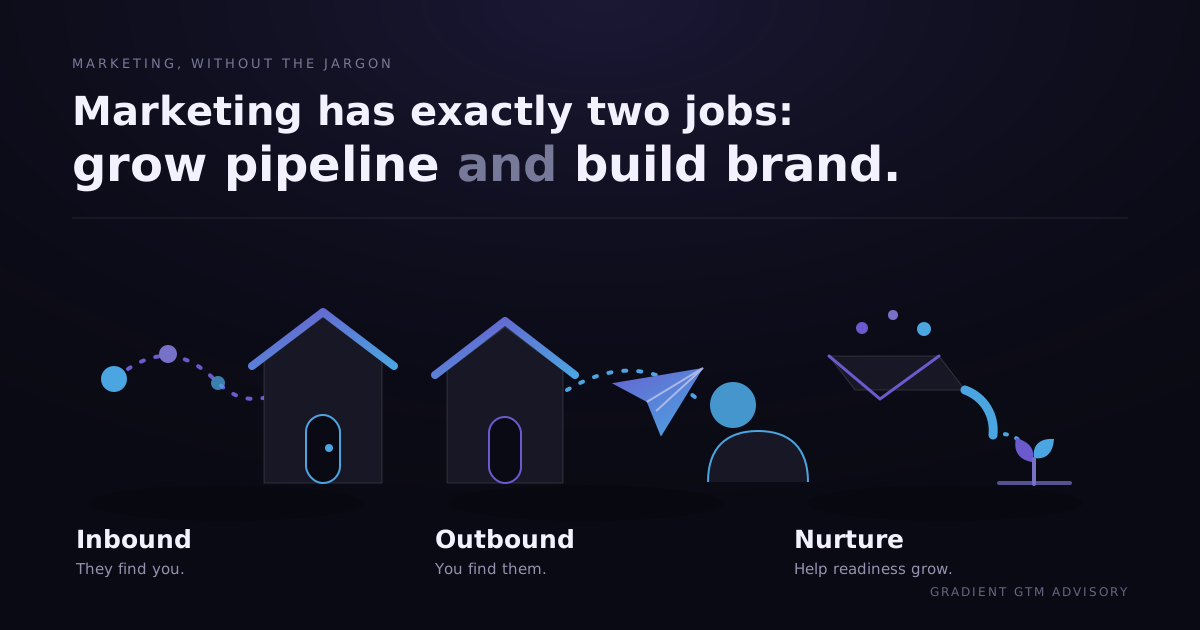
Marketing has two jobs and three doors. A practical guide to messaging, channel focus, offers, demand generation, and nurture for early-stage founders.
Read the article →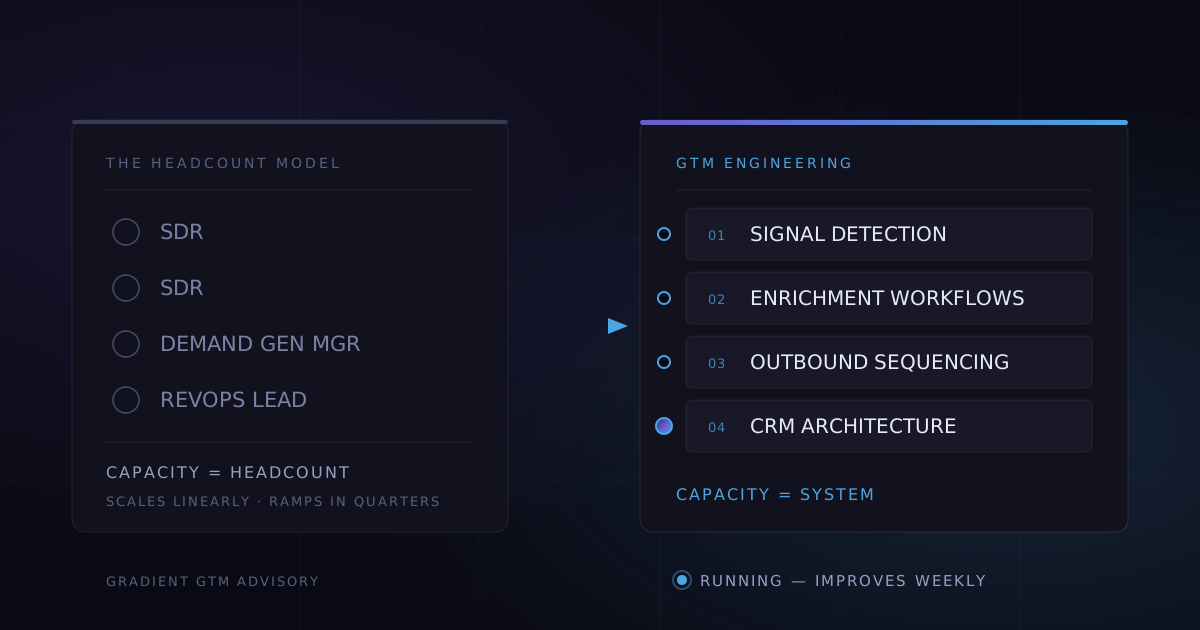
GTM Engineering
Why the next generation of go-to-market teams will be built by engineers, not filled with headcount.
Read the article →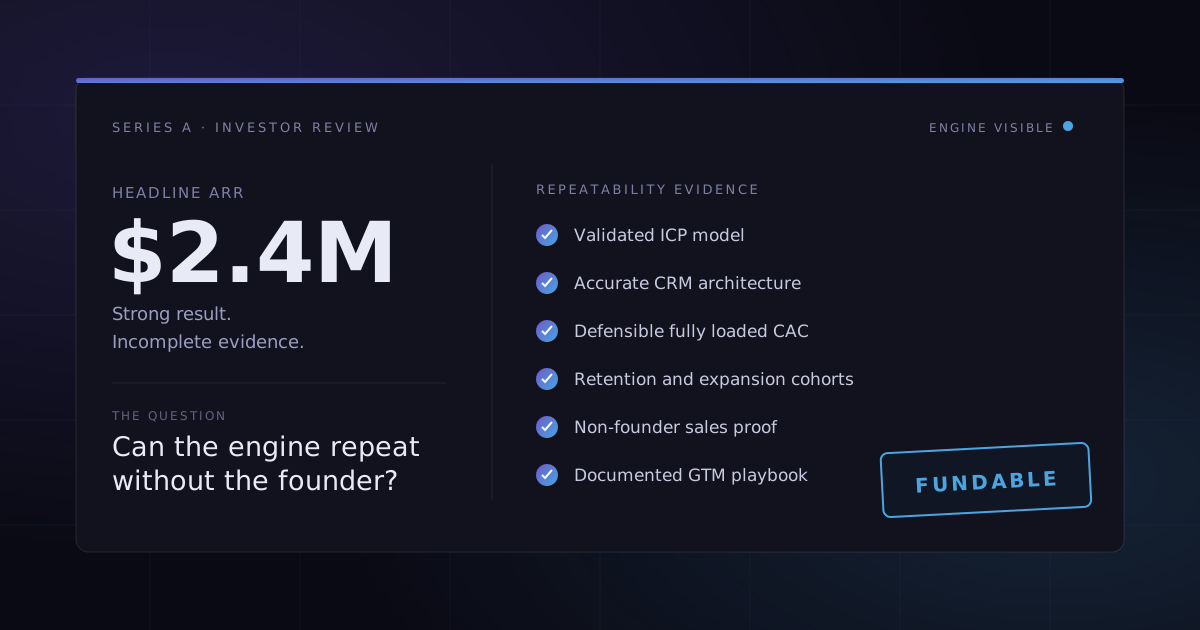
Series A Readiness
Strong ARR starts the conversation. Repeatable, non-founder-dependent GTM infrastructure is what gives investors conviction.
Read the article →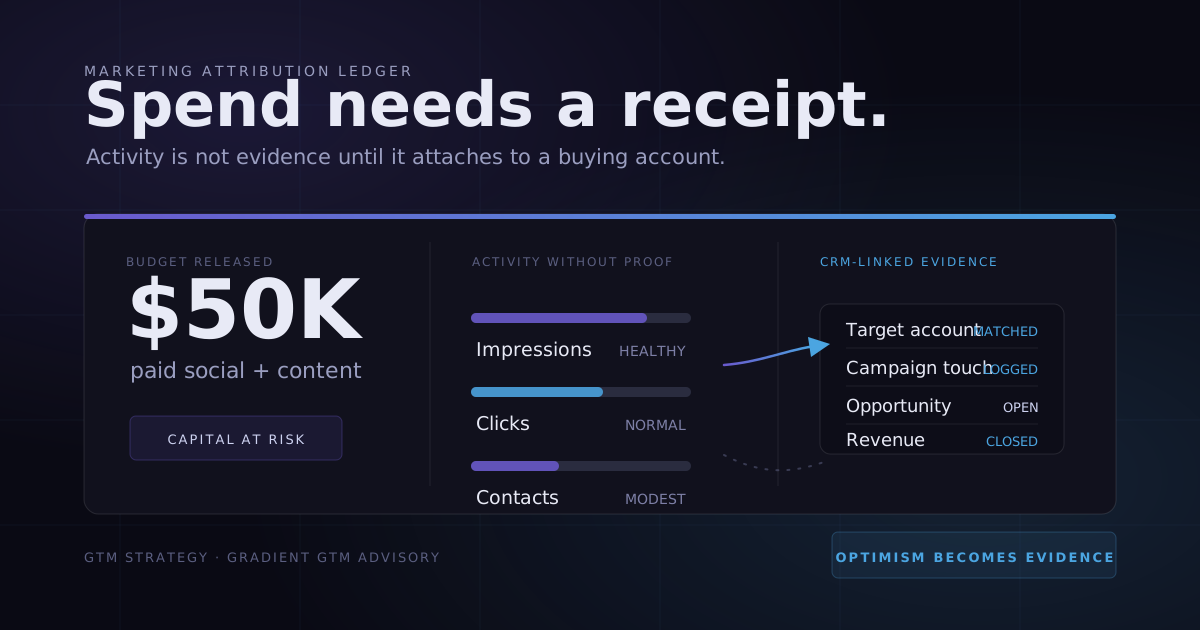
Marketing Attribution
The structural problem behind wasted marketing budgets — and why seed-stage teams need CRM-integrated attribution before scaling spend.
Read the article →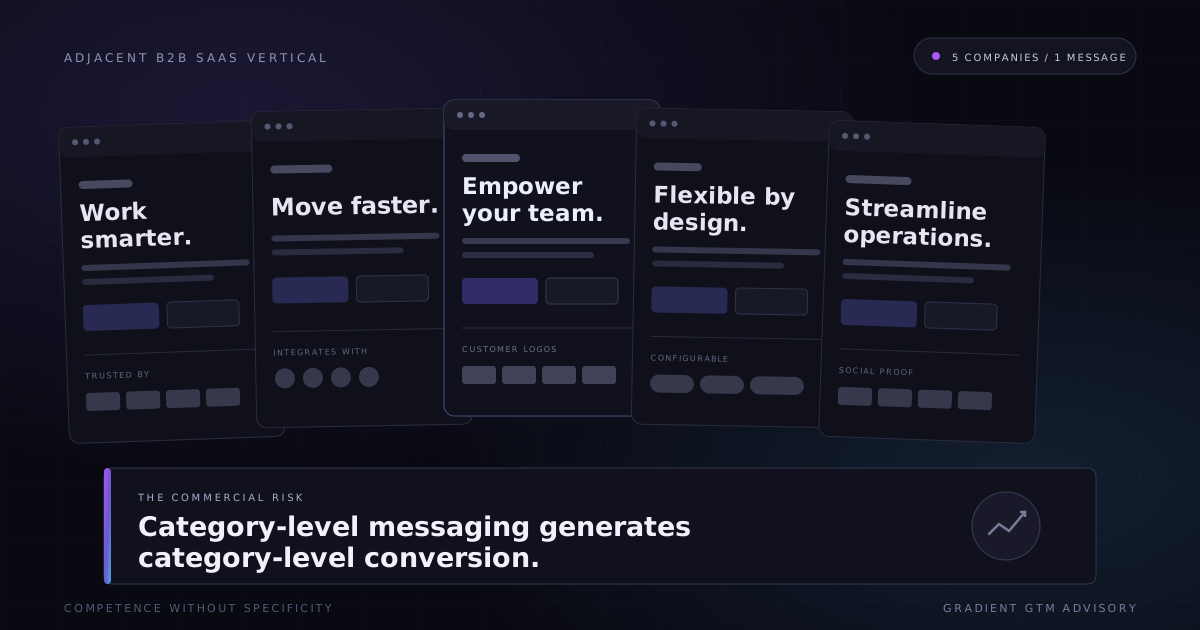
Value Proposition
When a company's positioning is indistinguishable from its category, it signals to a sophisticated B2B buyer that the company has not done the work to understand their specific operating context.
Read the article →
Sales Infrastructure
The founder is not a scalable sales channel. A 30-day sprint for codifying a founder's sales motion into transferable infrastructure — before the pipeline gap shows up in board conversations.
Read the article →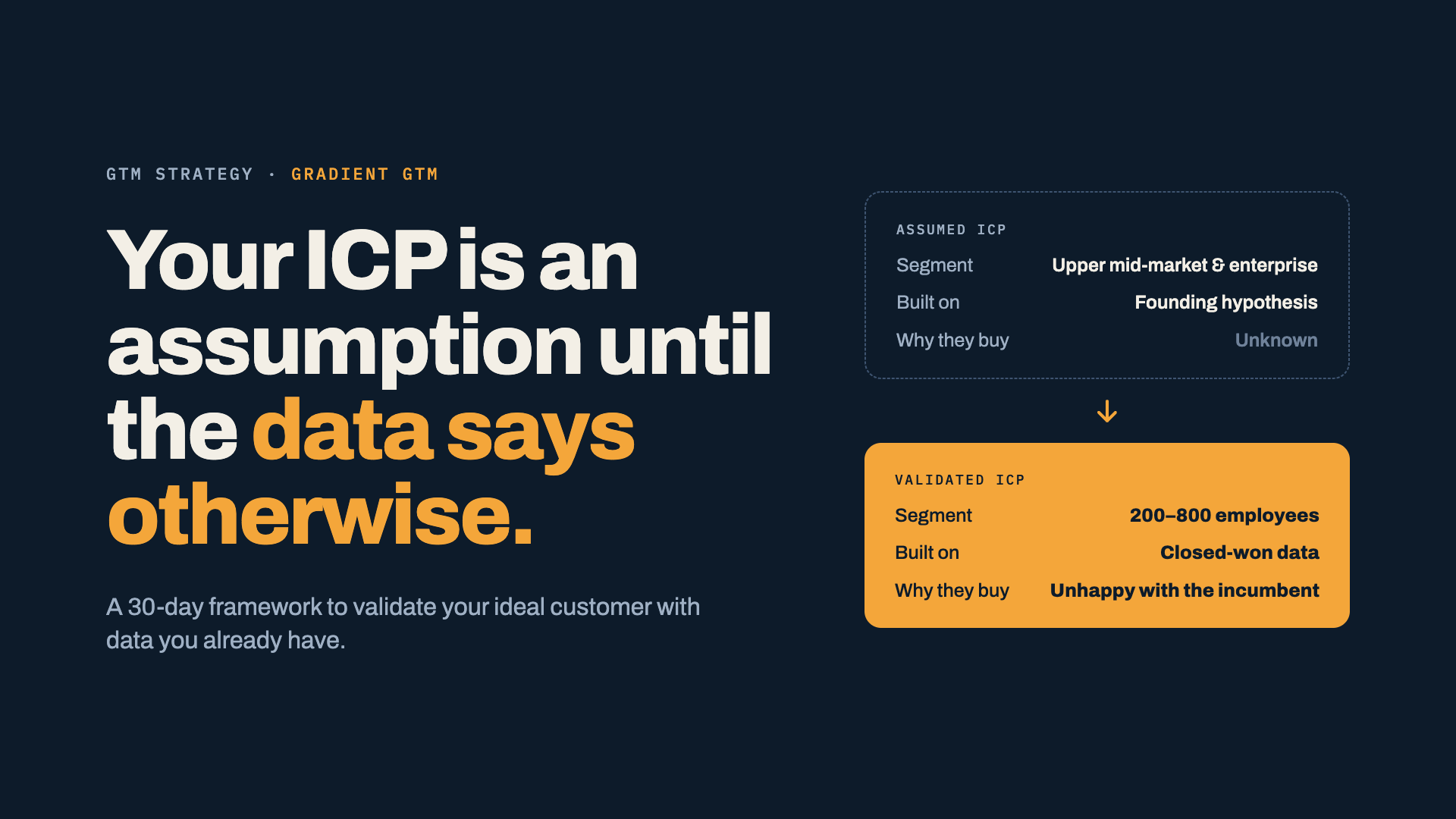
GTM Strategy
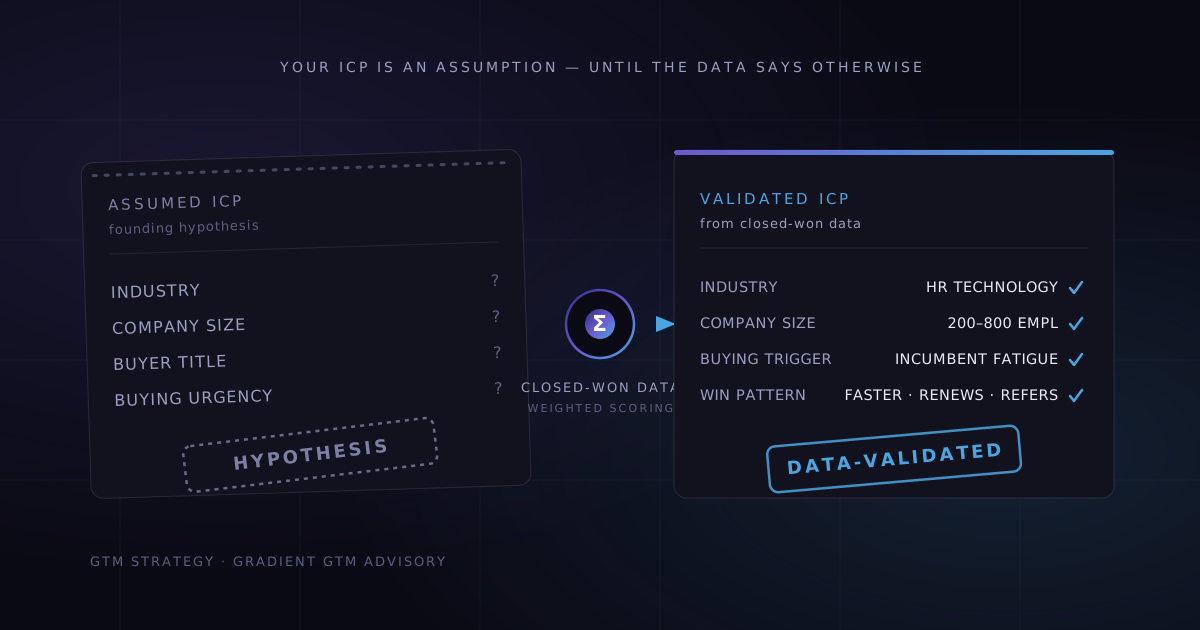
Most seed-stage founders can describe their ideal customer with confidence — but rarely have the evidence to back it. A disciplined, 30-day approach to replacing assumption with closed-won data.
Read the article →Marketing Fundamentals
A practical framework for building pipeline and brand before marketing becomes a department.
Founders who have never worked in marketing tend to treat it as a discipline that belongs to someone else — an agency, a hire they cannot afford yet, or a set of tactics half-remembered from a podcast. Stripped of the jargon, marketing has exactly two jobs: grow pipeline and build brand. Everything else, including the content calendar, the ads, and the swag, exists in service of one of those two outcomes.
There is one mechanism underneath both jobs: the customer journey. And there are three doors a prospect can walk through to arrive at their destination.
Marketing's actual role, stated plainly, is to give prospects reasons to consider the company before anyone ever picks up the phone, and to arm every conversation that happens after. Marketing does not close deals — sales does that. Marketing is what makes sales possible, and easier, before and during every call.
That framing matters most when pipeline stalls. The instinct is to spend more; the discipline is to first name which door is broken, and which stage of the journey is failing, before a dollar moves.
The most expensive mistake a non-marketer makes is spending money to promote a message that is not differentiated. It does not matter how good the channel is or how large the budget is. If the message underneath it is generic or misaligned, the spend is accelerating confusion, not pipeline.
Messaging must come before campaigns, always. A differentiated message does two specific things: it names the buyer's problem in their words, not the company's, and it answers why the buyer should choose this company over the status quo — not over Competitor X. At early stage, nobody is choosing between two vendors. They are choosing between a vendor and doing nothing, staying with the spreadsheet, or sticking with the manual process.
"A message built to win against a rival is solving a problem the buyer doesn't have yet." — Nick Fishman, CMO for IQubed
The deliverable at this stage is one sentence: the company's differentiated message, written against its ideal customer profile, naming the buyer's problem the way the buyer would name it. That sentence becomes the seed for the fuller messaging layer — the wedge and the pitch — that every later conversation should build toward.
The instinct at early stage is to be everywhere — a LinkedIn presence, a newsletter, some paid ads, maybe a podcast. The discipline is to resist it. Depth compounds. Spreading does not.
Pick one channel — the one place the ICP already pays attention — and go deep on it for sixty days before a second channel is considered. Attribution, at this stage, does not need a dashboard. It needs one sentence: ask every lead where they heard of the company and write it down.
The hardest part of this discipline is not choosing the channel. It is not adding channel two in week three, when channel one has not produced results yet and the temptation to hedge is highest. The leading indicator worth tracking is a real signal of buyer intent — replies, offer takes, booked calls — never impressions. Impressions confirm people saw something. They do not confirm anyone cared.
Once the message and the channel are set, the question becomes what to actually build. There is a standard menu of assets, and each does a different job — some are pipeline assets, built to move a specific prospect toward a conversation, and others are brand assets, built to compound trust over time.
The priority logic underneath the menu is simple: build whatever gives a prospect a reason to talk to the company first — a reason to take a call. That is what separates an offer from content. Content builds awareness; an offer converts attention into a conversation, and at this stage, that conversion is the whole game.
A landing page is not a homepage with a different URL. A homepage has to serve everyone — investors, candidates, existing customers, curious competitors. A landing page serves one purpose: converting one specific visitor, arriving with one specific intent, into one specific action. It needs exactly three things:
No navigation to wander off into, no second option to weigh. That is the conversion path, made physical.
"Paid search amplifies a message that's already converting organically. It never rescues one that isn't." — Jay Schlossberg, Head of Growth, Gradient GTM
For most companies in this position, the right paid budget in month one is zero. If the offer is not already producing replies and booked calls through organic effort, ad spend does not fix that. It just makes the failure more expensive. The landing page goes live when the offer ships; paid only enters the picture after the organic signal proves the message works.
Most of a company's total addressable market is not ready to buy right now. That is not a failure of messaging or channel selection — it is simply how buying works. Nurture is how a company stays top-of-mind as the buyer gathers information.
At early stage, the viable version of nurture is exactly one thing: an email worth reading. An email someone would genuinely want to open. Every landing page, every offer, every conversation is a chance to capture buyer information. Your contact list is the asset — a company cannot nurture someone it never captured.
Marketing, done honestly at this stage, is not a department or a budget line. It is a small number of disciplined decisions made in order: name the message before spending anything, pick one channel and stay in it, build the offer that earns a conversation, and nurture everyone who is not ready to buy yet.
At Gradient GTM, this is the frame we put in front of the non-marketer founders we work with. Seed-stage tech founders need a marketing engine that produces real pipeline, not a brand exercise. The goal is to craft your message, choose your channel, and create compelling offers.
That is a fundamentally different position to be in when the second door — outbound — opens next.
— Gradient GTM Advisory
Gradient GTM helps early-stage founders clarify the message, choose the channel, and build offers that create real pipeline.
Talk with Gradient GTM →GTM Engineering
Why the next generation of go-to-market teams will be built by engineers, not filled with headcount.
For the last decade, the standard answer to a revenue problem has been a hiring decision. Pipeline is short: hire SDRs. Marketing is underperforming: hire a demand gen manager. The motion is inconsistent: hire a RevOps lead. Headcount was the unit of go-to-market capacity, and the org chart was the system.
That model is breaking — not because the people are less capable, but because the leverage available to a small team has fundamentally changed. Enrichment platforms, sequencing infrastructure, signal data, and AI have made it possible for a two-person team to run a motion that previously required ten. The discipline of designing, building, and operating that leverage has a name: GTM engineering.
GTM engineering is the practice of treating your revenue motion as a system to be architected rather than a department to be staffed. It sits at the intersection of revenue operations, growth, and software — but it is not any one of them. A RevOps professional administers the tools. A growth marketer runs the campaigns. A GTM engineer builds the machine that does both, and instruments it so the founder can see exactly what is producing revenue.
"The question GTM engineering answers is not 'who should we hire to do this work?' It is 'why is a human doing this work at all?'"
The output of GTM engineering is not a strategy document. It is working infrastructure. In a typical build, that infrastructure includes:
The result is a motion where the machine does the volume and the humans do the judgment — discovery calls, deal strategy, and the conversations that actually close revenue.
GTM engineering is relevant at every stage, but it is decisive in the window between first traction and repeatable scale. A seed-stage company cannot afford the headcount model — five SDRs and a RevOps hire is a seven-figure annual commitment before the first meeting is booked. And a Series A or B company that scaled the headcount model is often discovering its unit economics: pipeline grew linearly with people, costs grew faster, and the motion still lives in individual reps' habits rather than in a system.
For both, the engineering approach inverts the math. The system is built once and improved continuously. Capacity scales with compute and iteration, not with recruiting cycles and ramp time. And because every touchpoint runs through instrumented infrastructure, attribution stops being a reconstruction exercise and becomes a property of the system itself.
"Headcount scales linearly and ramps in quarters. Systems scale with iteration and improve weekly. That difference compounds into the valuation conversation."
It is worth being precise about the distinction, because the terms are beginning to blur. Revenue operations is an administrative and analytical discipline — it manages the tools, maintains the data, and reports on the funnel. It is necessary, and it is not sufficient.
GTM engineering is a building discipline. It starts from the revenue outcome — qualified pipeline, at a target cost, at increasing volume — and architects backward to the system that produces it. It writes automation logic, designs data flows, and treats the outbound motion the way a software team treats a product: versioned, tested, measured, and improved. RevOps keeps the system running. GTM engineering is why the system exists.
The distinction matters for founders because the two hire (or buy) very differently. RevOps talent optimizes what you have. GTM engineering builds what you are missing — and at the stage where most founders are reading this, what is missing is the engine itself.
Three diagnostic questions surface whether GTM engineering is your current constraint:
A no on any of these is the signal. A no on all three is the roadmap.
Go-to-market is undergoing the same transition that IT operations went through a decade ago, when infrastructure stopped being racked by hand and started being written as code. The teams that made that shift early gained a compounding advantage that late adopters spent years closing. The same window is open in revenue right now — and it will not stay open long, because the tooling is no longer the barrier. The engineering discipline is.
At Gradient GTM, GTM engineering is the Ship stage of how we work: our GTM engineers design and build the outbound engines, enrichment workflows, and CRM architecture that our operators then run. The founders we work with do not end an engagement with a recommendations deck. They end it with a machine.
Gradient GTM designs, builds, and runs revenue systems for B2B software and AI founders, seed through Series B.
Series A Readiness
The GTM architecture and operating evidence that turn strong traction into investor conviction.
Founders preparing for a Series A raise frequently focus their preparation on the ARR number, the growth rate, and the product narrative. These matter. But the question that determines the outcome of most Series A conversations is one that many founding teams are not prepared to answer with precision: Can you demonstrate that the revenue you have produced is the output of a repeatable, non-founder-dependent commercial motion — and that the motion will continue to produce at an improving rate as capital is deployed against it?
A compelling ARR figure presented without structural evidence of repeatability is, from an institutional investor's perspective, an incomplete data set. It tells them that the company has found customers. It does not tell them that the company has built a system for finding customers consistently. Those are different propositions, and the difference determines whether the conversation results in a term sheet.
"Seed-stage investors are betting on the market and the team. Series A investors are betting on the engine. If the engine is not visible in the data, the conversation is about whether to build it — not whether to fund the company."
The most common failure mode in Series A preparation is timing. Founding teams begin assembling the evidence of GTM repeatability approximately 60 to 90 days before they need to close a round — a timeline that is sufficient to compile existing data, but insufficient to remediate the structural gaps that data reveals.
A CRM that has been operating without consistent deal stage discipline for 18 months cannot be reconstructed to show pipeline velocity trends in 60 days. An attribution model that was never built cannot produce a credible CAC calculation on short notice. A sales motion that has never been successfully executed by anyone other than the founder cannot be demonstrated as repeatable in a single quarter.
The companies that raise Series A rounds with favorable terms are those that built the GTM infrastructure on day one of their seed stage — not because they anticipated the fundraising conversation, but because they understood that the infrastructure was necessary for the commercial motion to function at all.
Based on the engagements we have conducted and the Series A processes we have supported, the following six elements constitute the minimum viable evidence set for a credible Series A GTM narrative. Most seed-stage companies can demonstrate one or two of them with confidence. The companies that close rounds on their terms can demonstrate all six:
The infrastructure failures that surface during Series A preparation are rarely the result of neglect. They are the result of a seed-stage team that was appropriately focused on product development and early revenue generation, and that deferred the work of building commercial infrastructure until the pressure to raise made it urgent.
The consequence is what we describe as GTM architecture debt: a CRM that was configured for early-stage convenience rather than long-term scalability; attribution logic that was never formalized because the founding team could reconstruct the pipeline story from memory; a sales motion that exists only in the founder's execution rather than in any documented system.
Like technical debt in product development, GTM architecture debt accumulates interest. The longer it is deferred, the more expensive it becomes to remediate — both in the direct cost of the remediation work and in the opportunity cost of operating a commercial motion that is less efficient than it could be.
The metrics that drive Series A conviction are not simply the headline numbers. They are the metrics that demonstrate trajectory, efficiency, and the structural soundness of the commercial motion. The five that carry the most weight in institutional investor conversations at this stage are:
"The founders who enter Series A conversations with all five of these metrics available and explained are not describing a business to investors. They are presenting a model — and a model is a fundamentally different kind of conversation."
For founding teams with 12 to 18 months of runway and a Series A target on a defined horizon, the most valuable investment of the first 90 days is not additional marketing spend or another product hire. It is the construction of the GTM infrastructure that will make every subsequent dollar of marketing spend more efficient and every subsequent investor conversation more credible.
Days 1 through 30 constitute the foundation phase: a full CRM audit and restructuring, definition of deal stages with explicit entry and exit criteria, application of the ICP scoring model to the existing pipeline, and initiation of the sales playbook documentation process.
Days 31 through 60 constitute the activation phase: deployment of structured outreach sequences against the validated target account list, launch of the first ABM content series, and establishment of the pipeline coverage ratio as a tracked operational metric.
Days 61 through 90 constitute the measurement phase: completion of the closed-won cohort analysis, construction of the investor metrics dashboard, identification of the highest-performing acquisition channels based on attribution data, and reallocation of budget accordingly.
The output of this sprint is not a polished investor presentation. It is a functioning commercial infrastructure that produces the data from which a credible investor presentation can be built — and that will continue producing that data as the company operates toward its Series A milestones.
The distance between a seed-stage company with strong ARR and a Series A-ready business is shorter than it appears and wider than most founding teams expect. The determining variable is rarely the market or the product. It is the quality of the commercial infrastructure that the team has built — and the degree to which that infrastructure produces evidence of repeatability, efficiency, and scale potential.
At Gradient GTM, this infrastructure work is the core of what we do for seed-stage founders in fintech and HR tech. The companies we work with do not arrive at their Series A process hoping their pipeline data tells the right story. They arrive having built the systems that generate the right story operationally, over time, in the course of running the business.
That is a fundamentally different position to be in when the conversations that matter most begin.
— Gradient GTM Advisory
Gradient GTM helps seed-stage founders turn commercial traction into a repeatable, measurable system that stands up in Series A diligence.
Book a GTM conversation →Marketing Attribution
The structural problem behind most wasted marketing budgets.
A seed-stage B2B company allocates $50,000 for paid social and content distribution. Impressions perform as expected. Click-through rates fall within industry benchmarks. Inbound contact volume increases modestly. And at the end of the quarter, when the leadership team attempts to connect that spend to closed-won revenue, they find that the attribution trail effectively does not exist.
This is not an unusual outcome. It is the predictable consequence of a go-to-market model that was built to generate marketing activity before it was built to measure marketing impact. The result is that the company cannot determine which dollar of spend is contributing to pipeline, which channels are reaching their actual ICP, or which campaigns justify continuation. In the absence of that information, the default decision is to continue spending at roughly the same level and hope the output improves.
At the seed stage, that default is a strategic liability. With 12 to 18 months of runway and a Series A conversion target that typically requires demonstrable CAC efficiency, the cost of operating without attribution is not simply wasted budget. It is wasted time in a window where time is the scarcest resource.
"The question a seed-stage CEO should be able to answer is not how much revenue marketing generated. It is which specific activities, channels, and content assets are touching the accounts that close, and at what cost per closed dollar."
The commercial logic that drives broad-based digital advertising is structurally misaligned with the buying dynamics of B2B SaaS products, particularly in verticals like fintech infrastructure and compliance technology where purchasing decisions involve multiple stakeholders and extended evaluation cycles.
Three structural mismatches explain the consistent underperformance of unfocused digital spend in this context:
Across the engagements we have conducted with seed-stage B2B companies, a consistent pattern emerges in closed-won attribution analysis: a small subset of marketing activities, typically representing 20% of total spend, accounts for 80% of the pipeline that converts to closed-won revenue. The remaining spend either does not reach the ICP in a meaningful way, or reaches them without sufficient relevance and timing to influence a buying decision.
Identifying that high-performing 20% before it has been diluted by 12 months of undifferentiated spend is the central objective of a properly structured attribution model. The methodology is straightforward:
"Attribution is not a reporting exercise. It is a capital allocation decision. The companies that build attribution logic into their CRM architecture before they scale their marketing spend consistently achieve better CAC efficiency than those that build it after."
Attribution is a measurement discipline, not an end in itself. The underlying objective of any marketing motion is not to generate activity that can be tracked. It is to acquire customers and produce revenue. Account-Based Marketing matters because it is one of the few approaches at the seed stage that is built to do exactly that, and it resolves the attribution problem as a byproduct of doing it well.
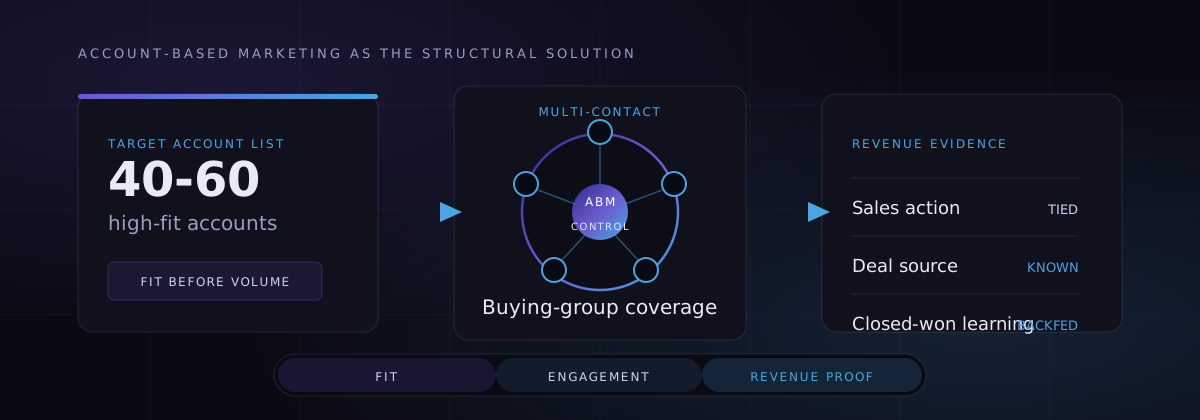
Rather than generating lead volume and attempting to identify which leads match the ICP, ABM begins with a defined list of high-fit target accounts and concentrates all marketing and sales activity on those accounts specifically, converting marketing spend directly into a pipeline of buyers, not a pipeline of impressions.
For seed-stage B2B companies, this typically means identifying a list of 40 to 60 accounts that score above threshold across the validated ICP model, accounts where recent funding activity, executive hiring patterns, LinkedIn engagement, and firmographic fit converge to indicate active buying potential in the current quarter.
Execution against that list runs on two coordinated motions. The first is direct, multi-contact engagement: email, LinkedIn outreach, and sales conversations addressed to specific buyers at specific accounts, sequenced so that no single point of contact is the only path to a deal. The second is brand recognition built specifically among that account list: content, points of view, and a consistent presence in the channels those buyers already pay attention to, so that by the time direct outreach lands, the company is not a stranger.
The CAC reduction that results from this approach does not come from spending less. It comes from eliminating the structural waste that broad targeting produces, and from concentrating effort, both direct outreach and brand-building, where the probability of conversion is highest.
Before allocating budget to the next marketing initiative, a seed-stage leadership team should be able to answer four specific questions:
If those questions cannot be answered with confidence, the company does not have a spending problem. It has a measurement architecture problem. Resolving that architecture problem is the precondition for making informed capital allocation decisions at every subsequent stage of growth.
Fix the measurement architecture
Gradient GTM helps seed and Series A teams connect ICP validation, attribution logic, and account-based execution into a commercial motion that can be measured and improved.
Start the conversation →GTM Strategy
Most seed-stage founders can describe their ideal customer with confidence. They have an archetype, a job title, a company size, an industry, and they have built their early sales motion around it. What they rarely have is evidence that the archetype reflects their actual closed-won customers rather than the buyers they hoped to attract.
This distinction matters more than most founding teams recognize. The gap between an assumed ICP and a data-validated one is precisely where marketing budgets erode, sales cycles extend, and pipeline coverage ratios fall short of what investors expect to see at the Series A. Closing that gap does not require a research firm or a six-month strategy engagement. It requires a disciplined 30-day process applied to data most companies already have.
"An ICP built on pattern recognition from your best customers is a competitive asset. An ICP built on a founding assumption is a liability that compounds over time."
In the early stages of a company, the founding team closes deals through a combination of network access, personal credibility, and a pitch that can flex in real time to match each buyer's priorities. This creates a misleading signal: because the founder can sell to a wide range of profiles, the team concludes that a wide range of profiles constitutes the ICP.
The reality is that the founder's ability to close broadly masks the fact that only a subset of those buyers will renew, expand, and refer. When the company attempts to build a repeatable sales motion and hand it off to a revenue team, the breadth of the original ICP makes it nearly impossible to train, message, or prioritize effectively. The three most common structural failures we see in seed-stage GTM models reflect this directly:
Decision science, as applied to go-to-market strategy, is the practice of replacing instinct-driven prioritization with a structured, weighted scoring framework. Rather than relying on a sales leader's judgment about which accounts to pursue, the model applies consistent logic across every potential customer and surfaces the highest-probability targets based on measurable criteria.
At Gradient GTM, the ICP scoring model we deploy for seed-stage B2B companies evaluates accounts across five weighted dimensions:
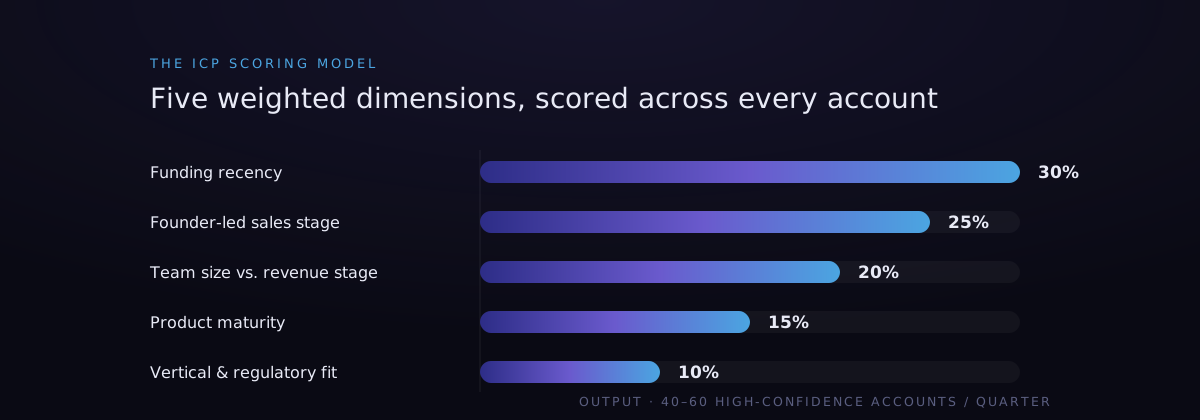
When this model is applied to an Apollo or ZoomInfo export of several thousand potential accounts, the output is not a ranked list of 10,000 targets. It is a high-confidence list of 40 to 60 accounts that meet the threshold across all six dimensions and carry active buying signals in the current quarter.
The practical impact of moving from an assumed ICP to a scored model is visible almost immediately in how the sales and marketing teams operate. Outreach becomes more targeted and better researched. Messaging becomes more specific to the buyer's actual environment. Discovery calls produce higher-quality information because the team arrives knowing what problem they are there to solve.
In one recent engagement, a client in the HR technology space came to us convinced their ICP was upper mid-market and enterprise. Their product was well-built, their team was capable, and their ambition was legitimate. But when we ran their closed-won data through the scoring model, a different picture emerged: their highest-converting accounts were lower mid-market companies (typically 200 to 800 employees) that were actively dissatisfied with the dominant incumbent in their space and looking for a more responsive, cost-effective alternative. Those deals closed faster, renewed at higher rates, and generated referrals.
The enterprise accounts, by contrast, surfaced product gaps the team had not yet built against: global payroll capabilities, multi-entity support, enterprise-grade SLAs. The instinct was to build toward those requirements. The risk was that doing so meant chasing a segment that would always need more than the product could currently deliver while diverting attention and engineering capacity away from the segment where the product was already winning. Concentrating revenue in one or two large enterprise accounts at that stage would also have created a fragility the business was not yet positioned to absorb.
"The value of a precise ICP is not that it limits your opportunity. It is that it concentrates your effort where the probability of return is highest."
A well-constructed ICP is one of the highest-leverage assets a seed-stage company can build. It improves the efficiency of every downstream investment — content, outreach, sales enablement, paid media — by ensuring that effort concentrates where the probability of return is statistically highest.
At Gradient GTM, ICP validation is the foundational step in every engagement we undertake. Before we activate a single outreach sequence or allocate a dollar of marketing spend, the target account model must be grounded in closed-won data rather than founding hypothesis. That discipline is not a constraint on growth. It is the precondition for it.
Go deeper
Move from ad hoc selling to a defined, repeatable motion. Built for founders and early GTM leaders who need to align their team, enable their first hires, and build the commercial engine that scales.
Get the playbook →Sales Infrastructure
The founder is not a scalable sales channel.
There is a well-documented pattern in early-stage B2B companies. The founder closes the first 10 to 20 deals through a combination of personal network access, deep product knowledge, and the ability to customize the pitch in real time for each buyer. Revenue grows. The board signals satisfaction. And then, at some point in the 12 to 24 months following the seed close, pipeline velocity stalls — not because the market has shifted or the product has deteriorated, but because the company has built its entire commercial motion around a single person who cannot scale.
Founder-led sales is an appropriate and often necessary strategy at the pre-product-market-fit stage. It becomes a structural liability the moment the company attempts to build a repeatable revenue engine. Recognizing that inflection point — and acting on it before the pipeline gap becomes visible to investors — is one of the most consequential decisions a founding CEO will make in the seed stage.
"The founder's ability to sell is an early-stage asset. The founder's dependence on selling is a late-stage constraint. The transition between those two states requires deliberate architecture, not incremental hiring."
The most common approach to exiting founder-led sales is to hire an experienced account executive and rely on their professional background to fill the gap. This approach fails at a predictable rate for a consistent reason: the institutional knowledge that makes the founder effective — the specific questions they ask in discovery, the objections they have learned to anticipate, the language that resonates with their buyer's specific operating context — exists nowhere in the company's systems. It exists in the founder's head.
When that knowledge is not codified before the first revenue hire arrives, the new hire is not inheriting a sales motion. They are being asked to reconstruct one from scratch while simultaneously carrying a quota. The resulting performance gap is not a hiring failure. It is an infrastructure failure that the hiring decision exposed.
The diagnostic indicators that a company is approaching this inflection point are consistent across engagements:
The process of codifying a founder's sales motion into transferable infrastructure is a focused sprint, not a long-term project. It does not require a sales operations hire or a consultant. It requires discipline and approximately four weeks of structured documentation work.
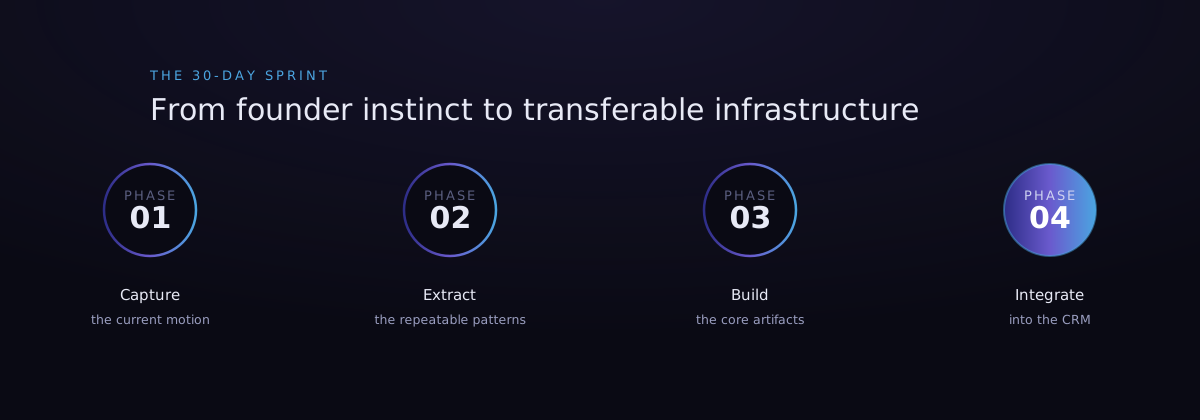
Phase One — Capture the Current Motion. Record every customer-facing conversation for a two-week period: discovery calls, demonstrations, objection-handling exchanges, and close calls. The objective is not to produce polished training material. It is to create a raw, unfiltered record of how the founder actually sells — the specific questions asked, the language used, the moments where buyer engagement increases or decreases.
Phase Two — Extract the Repeatable Patterns. Review the recordings with the specific objective of identifying: the discovery questions that consistently surface the buyer's core pain; the objections that appear across the majority of deals; the language and framing that moves conversations from evaluation to commitment; and the points in the process where the founder's instinct is doing work that a structured prompt or template could replicate.
Phase Three — Build the Core Artifacts. Translate those patterns into four foundational documents: a structured discovery call framework with sequenced questions and branching logic based on common responses; an objection-handling guide organized by the frequency and stage at which each objection typically appears; a demonstration script that accommodates the two or three most common buyer profiles; and a closing sequence with defined follow-up templates and timing guidelines.
Phase Four — Integrate into the CRM Architecture. Configure deal stages with explicit entry and exit criteria. Build automated internal notifications that alert the appropriate team member when a deal advances or stalls. Establish the sequence templates that will govern outreach at each stage of the pipeline. The system should be navigable by a capable revenue professional who has never met the founder.
"The goal of this process is not to produce a replica of the founder's sales judgment. It is to produce a documented motion that a capable professional can execute consistently — and that the founder can improve systematically rather than manage personally."
Modern CRM and sales automation infrastructure has meaningfully changed the calculus of early-stage team building. An SDR operating within a well-configured outreach environment — with defined sequences, AI-assisted lead scoring, structured call preparation, and automated follow-up logic — can sustain the output that previously required a larger team. This matters for seed-stage companies specifically because it delays the overhead of building a traditional sales function until the unit economics justify it.
The architecture that supports this model is not complex. It requires a CRM configured with intentional deal stage logic, sequences calibrated to the validated ICP, and a documented playbook that provides the SDR with the context and language to conduct a credible first conversation. The founder's role, once this infrastructure is in place, shifts from executing the sales motion to coaching and refining it — which is the appropriate use of the founding CEO's time at this stage of company development.
The transition out of founder-led sales is not primarily a hiring decision. It is an infrastructure decision that a hiring decision will eventually require. Companies that build the playbook, configure the systems, and document the motion before they hire will consistently outperform those that hire first and build later — because the hire is only as effective as the environment into which they are deployed.
The window to build this infrastructure is narrower than most founders expect. The right time to start is before the pipeline gap is visible, not after it has begun to affect board conversations about growth trajectory.
Start the sprint
The discovery frameworks, objection-handling guides, demo scripts, and CRM deal-stage architecture from the four-phase sprint — packaged so a capable revenue hire can execute the motion without ever sitting next to you. Built from real seed and Series A engagements.
Get the Sales Playbook →Value Proposition
When the Category Speaks Louder Than the Company
Examine the homepage of any five B2B SaaS companies operating in an adjacent vertical, and you will likely find a consistent pattern: hero headlines built around operational efficiency, platform flexibility, and team empowerment. Subheadings that describe integrations and configurability. Social proof organized around customer logos rather than specific outcomes. The visual language of competence without the specificity of differentiation.
This is not an aesthetic problem. It is a commercial one. When a company's positioning is indistinguishable from its category, it signals to a sophisticated B2B buyer that the company has not done the work to understand their specific operating context — or has chosen to address everyone at the expense of resonating deeply with anyone. In a competitive evaluation, that signal reduces consideration before the sales conversation begins.
"Category-level messaging generates category-level conversion rates. For a seed-stage company that needs to win a disproportionate share of a focused target market, that is not a viable outcome."
Undifferentiated messaging has compounding effects across the revenue funnel that are frequently misdiagnosed as sales performance issues or product-market fit gaps. At the top of the funnel, it reduces the signal-to-noise ratio of outbound campaigns because the value proposition does not resonate at the level of specificity that B2B buyers require to engage. At the mid-funnel, it extends the sales cycle because buyers cannot clearly articulate to internal stakeholders why this vendor is the appropriate choice for their specific problem. At the close, it reduces win rates against competitors whose positioning, even if operationally equivalent, more precisely addresses the buyer's stated priority.
Seed-stage companies are particularly exposed to this risk because they do not yet carry the brand equity that allows established platforms to sustain vague positioning. Without a recognized name, without an extensive review volume, and without the reference network that later-stage companies can deploy, the messaging itself must do the work of creating initial credibility and relevance.
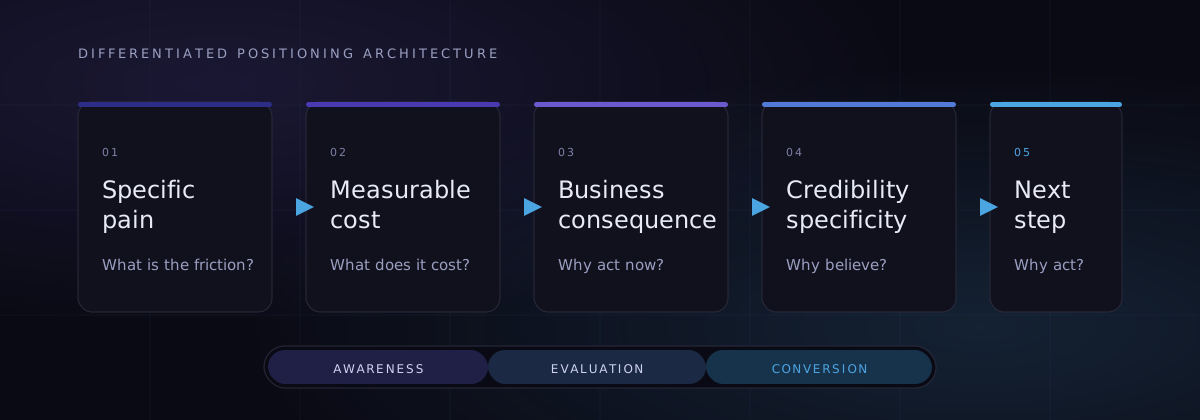
Effective B2B messaging for a seed-stage company operates at three levels simultaneously. Most companies reach the first level inconsistently. Companies that achieve all three create a compounding advantage in every channel where their message appears.
The first layer is specificity of pain. The positioning must name the particular operational problem the buyer is managing — not the category of problem, but the precise friction point with a measurable cost attached to it. 'Your compliance review process is creating a three-week delay at every contract cycle' is a pain statement. 'Streamline your compliance operations' is a category description. The former creates recognition; the latter creates indifference.
The second layer is consequence framing. Once the pain is named, the positioning must connect it to a business consequence that creates urgency — a regulatory exposure, a cost that scales with headcount, a competitive disadvantage that compounds over time. The buyer must understand not just that the problem exists, but what it is costing them to leave it unresolved. This is the layer that moves a potential buyer from passive awareness to active evaluation.
The third layer is credibility specificity. This is where the company demonstrates that it has solved this problem before — not in general terms, but for an organization that resembles the buyer's own. Not a case study that describes a transformation journey. A discrete outcome statement with a named metric, a timeline, and a customer profile that the buyer can recognize as relevant to their context.
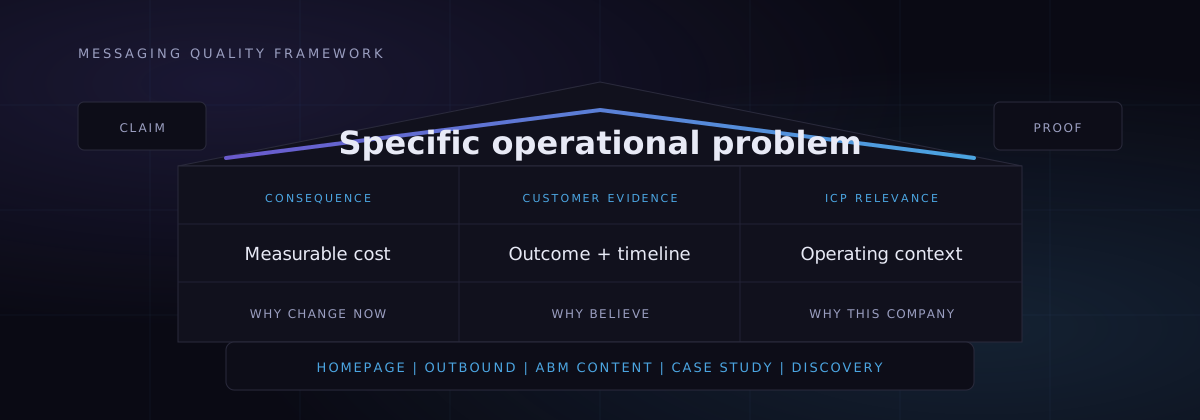
Before investing in a website rebuild, a campaign refresh, or a brand engagement, a founding team should evaluate their current positioning against five specific criteria:
A company that cannot answer all five of these affirmatively has a positioning gap that is suppressing performance across every go-to-market channel. Addressing it does not require a full rebrand. In our experience, a focused messaging sprint of two to three weeks grounded in discovery call analysis and ICP validation data is sufficient to produce a material improvement in top-of-funnel conversion and sales cycle efficiency.
"The most effective B2B messaging we encounter at the seed stage does not originate in brand strategy sessions. It originates in the language that a company's best customers use to describe the problem they hired the product to solve."
One structural benefit of an account-based marketing approach is that it forces the kind of messaging specificity that broad-based campaigns do not require. When the team is creating content for a defined list of 50 accounts in a specific vertical and company stage, generic positioning is not viable — the content must address the operational reality of that buyer's world in order to generate engagement.
Companies that have operated in ABM mode for two or three quarters consistently find that the specificity developed for their target account content migrates upward into their broader positioning. The homepage improves. The outbound sequences improve. The sales team's language in discovery calls improves. This is not a coincidence — it is the natural output of a go-to-market motion that requires the team to stay close to the specific language and concerns of their most valuable buyers.
— Gradient GTM Advisory
Audit the message before scaling spend
The checklist helps founders and early GTM leaders pressure-test messaging, CRM readiness, attribution, and sales scripts before putting more dollars behind acquisition.
Get the checklist →Resources
Practical GTM resources built from real engagements. Free to use — no strings attached.
The Runway Saver
70% of Seed startups fail because they scale marketing before they find product-market fit. A 10-point audit to see whether your CRM, messaging, and sales scripts are ready — before you commit real dollars to ad spend.
Free. No pitch. Quick form so we know who it's going to.
Sales Framework
Built for founder-led and early commercial teams. Clean pipeline, honest forecasts, and a framework that maps to how deals actually move — with exit criteria, failure modes, and forecast benchmarks at every stage.
Free. No pitch. Just a quick form so we know who it's going to.
GTM Enablement
Move from ad hoc selling to a defined, repeatable motion. Covers GTM motion types, ICP operationalization, sales narrative, first hire enablement, and the leading indicators that predict revenue before it closes.
Free. No pitch. Quick form so we know who it's going to.
Revenue Operations
How revenue actually happens — and where it breaks. A complete operating model for funnel math, pipeline coverage, and velocity with live calculators and a diagnostic for the five failure modes that quietly kill forecasts.
Free. No pitch. Quick form so we know who it's going to.
Contact
Gradient GTM works with a small number of companies at a time to make sure every engagement is substantive. If you're a tech founder at seed through Series B thinking about GTM, pipeline, your first revenue hire, or how to build the motion before you scale headcount — we'd like to hear from you.
Tell us a bit about where you are and what you're working on. We'll respond within one business day.
Response time
Typically within one business day. If there's mutual fit, we'll schedule a 30-minute discovery call.
Jenn speaks on topics including early-stage GTM strategy, revenue architecture, AI-augmented sales teams, and building for acquisition. If you'd like to explore a speaking engagement, podcast appearance, or interview, please share the details below.
We'll follow up within one business day.
↓ Download media kitFree resource
Built for founder-led and early commercial teams under $100M ARR. Clean pipeline, honest forecasts, and a framework that actually maps to how deals move.
What's inside
Jenn Tomassi
Founder, Gradient GTM
Free. No pitch. Just tell us a bit about where you are.
Free resource
Move from ad hoc selling to a defined, repeatable motion. Built for founders and early GTM leaders who need to align their team, enable their first hires, and build the commercial engine that scales.
What's inside
Jenn Tomassi
Founder, Gradient GTM
Free. No pitch. Just tell us a bit about where you are.
Free resource
How revenue actually happens — and where it breaks. A complete operating model for funnel math, pipeline coverage, velocity, and the five failure modes that quietly destroy forecasts.
What's inside
Jenn Tomassi
Founder, Gradient GTM
Free. No pitch. One question so we understand where you are.
Free resource · The Runway Saver
According to CB Insights, 70% of Seed startups fail because they scale their marketing before they find product-market fit. This 10-point audit tells you whether your CRM, messaging, and sales scripts are actually ready — before you put real dollars behind paid acquisition and burn runway you can't get back.
What's inside
Jenn Tomassi
Founder, Gradient GTM
Free. No pitch. One question so we understand where you are.
HRTech
A decade operating inside HR technology — scaling a healthcare vertical from $25M to $150M, launching a new product from $0 to $30M, and helping carry the company to an IPO and a $2.2B exit. Gradient GTM brings that operating history to HR tech founders at seed through Series B.
The problem
Every HR tech founder discovers the same three walls. The buyer is overwhelmed — HR leaders field more vendor outreach than almost any function in the enterprise, and undifferentiated messaging dies on arrival. The sale is multi-stakeholder — HR owns the problem, but finance owns the budget, IT owns the integration, and legal owns the risk, and a motion built for one buyer stalls against four. And the category is crowded — hundreds of point solutions claiming efficiency and empowerment, where sounding like the category means losing to it.
Winning here isn't about more outreach. It's about a sharper ICP than your competitors, messaging built in the buyer's operational language, and a motion engineered for committee sales — the exact system we spent a decade building at scale.
The receipts
$0M
HR tech vertical scaled from $25M under direct leadership
$0M
New product launched from zero into a segment that hadn't seen innovation in years
$0B
Strategic exit at a 35% premium, built on GTM discipline
A decade at Sterling Check and First Advantage — background screening, credentialing, and workforce technology sold into HR, talent, and compliance buyers at every company size.
What we do for HR tech founders
Everything on our services page, aimed at your market: ICP models scored on the signals that matter in HR tech — funding, headcount inflections, incumbent dissatisfaction. Messaging architecture that speaks operational pain, not category language. Outbound engines targeting the HR, talent, and compliance titles that actually buy. And the sales infrastructure to run multi-stakeholder deals to close — champion enablement, committee navigation, and forecast discipline.
See how we work →Proof
Greatpoint HR
Andrew Kalogerakis
Founder
“Jenn picked up the patterns in our motion fast and gave us a phased plan instead of a list of opinions. That’s the kind of voice you want in the room.”Read the founder story →
Talent4cast
Jamie Dillon
Founder
“Jenn ran a 30-minute diagnostic that gave me more clarity than I’d built in the previous year.”Read the founder story →
From the field
GTM Strategy
Most seed-stage founders can describe their ideal customer with confidence — but rarely have the evidence to back it. A disciplined, 30-day approach to replacing assumption with closed-won data.
Read the article →
Sales Infrastructure
The founder is not a scalable sales channel. A 30-day sprint for codifying a founder's sales motion into transferable infrastructure — before the pipeline gap shows up in board conversations.
Read the article →
Value Proposition
When a company's positioning is indistinguishable from its category, it signals to a sophisticated B2B buyer that the company has not done the work to understand their specific operating context.
Read the article →Talk with an operator who's carried an HR tech number at every stage you're heading toward.
Contact the Gradient GTM team →FinTech
Fintech GTM is a different sport: regulated buyers, compliance gates on every deal, and risk owners whose job is to find the reason not to sign. Gradient GTM builds the revenue systems that win those sales — ICP models that account for regulatory posture, messaging that survives a risk review, and a motion engineered for the committee that actually decides. Seed through Series B.
The problem
A fintech deal rarely dies in the demo. It dies in the review. Compliance asks a question the deck doesn't answer, security sends a questionnaire nobody owns, and legal finds an indemnity clause that stalls the quarter. The economic buyer wants the product; the organization is structured to slow it down.
The fix isn't more pipeline. It's a motion that anticipates the review instead of reacting to it — qualification that surfaces regulatory blockers before they cost you a quarter, proof assets built for risk owners, and a champion equipped to sell internally when you're not in the room.
What we do for fintech founders
Everything on our services page, aimed at your market: ICP models scored on the signals that predict a winnable regulated deal. Messaging architecture that holds up in a risk review, not just a first call. Outbound engines targeting the finance, risk, and operations titles that actually buy. And the sales infrastructure to carry multi-stakeholder, compliance-gated deals to close — champion enablement, committee navigation, and forecast discipline that survives a long review cycle.
See how we work →From the field
GTM Strategy
Most seed-stage founders can describe their ideal customer with confidence — but rarely have the evidence to back it. A disciplined, 30-day approach to replacing assumption with closed-won data.
Read the article →
Value Proposition
When a company's positioning is indistinguishable from its category, it signals to a sophisticated B2B buyer that the company has not done the work to understand their specific operating context.
Read the article →
Sales Infrastructure
The founder is not a scalable sales channel. A 30-day sprint for codifying a founder's sales motion into transferable infrastructure — before the pipeline gap shows up in board conversations.
Read the article →Talk with an operator who's built revenue systems for compliance-heavy, multi-stakeholder sales.
Contact the Gradient GTM team →